
Dire Straits
What the current Iran operation illustrates for China, Taiwan and the A.I. Industry
When the Trump administration entered the White House in January last year, three stories immediately gripped the American news media: Greenland, Panama, and the Gulf of Mexico. In typical fashion, Trump’s bullish and obtuse comments caused furour—not only because of their brusqueness, but also their apparent frivolity. In essence, Greenland should be American, the Panamanians were captured by the Chinese, and the Gulf should be renamed “The Gulf of America.” As scattered as each of these ideas might appear, there is a common, coherent thread. Each issue is emblematic of Trump’s mercantile desire to reignite American hegemony and secure maritime trade in its own hemisphere—and more specifically, the desire to decrease Chinese influence. In other words, each issue is a microcosm of a broader grand strategy, at the heart of which is a resuscitation of American control of the seas and lines of communication. This chest-beating policy is largely directed at China, which threatens to undermine the American AI industry and economy at large.
However, one year on, the administration is dealing with an arguably self-inflicted maritime predicament. As the war in Iran enters its third week, trade in the Strait of Hormuz has been brought to a grinding halt. This has not only affected the price of oil, but is threatening to affect the AI industry, particularly in Asia. Moreover, the contemporary consequences of this closure is a stress test, or perhaps even a preview of a worse scenario—the closing of the Taiwan Strait. This article will analyse the current effects of a kinetic block on a major trading route, using it as a case study to envisage the implications for the not-so-distant future of US and Taiwanese security, maritime trade, and the AI industry.
The Current Strait Crisis
War-games and simulations have for decades attempted to predict the waterfall effects of various disrupted maritime chokepoints—but today there is an active crisis. As the US-Israeli led military operation against the IRGC continues, missile and drone attacks, and the threat of sea mines, persist in the Straits of Hormuz, effectively bringing its transit to a standstill. The AIS data reflects this, with ship transit dropping to near zero since March 10, even among PRC and Hong Kong-flagged ships. Despite assurances from the US administration and attempts to provide political risk insurance, the strait is technically open but functionally closed, additionally complicating maritime trade across the entire region.
The importance of the Strait of Hormuz is sizeable: according to the Modern War Institute, the ongoing disruption, “affects about 20 percent of global petroleum.” But the closure has not only affected global oil prices and the price you see at the gas pump; it is affecting helium, aluminium, and LNGs (Liquid natural gas), the latter of which has been halted by Qatar, which provides about one fifth of the world’s supply. As David Fickling at Bloomberg put it succinctly, “Hormuz is a hidden shoal for the AI economy.” The shoal has had an immediate hull-denting effect on the South Korean chip industry. Because of their energy-poor economy, which is largely reliant on Qatari LNG, South Korea was particularly vulnerable, and the country’s stock market plunged 18 percentage points in four trading days, wiping out $500 billion in market value. If the closure in the straits continues, both South Korea and Taiwan might struggle for power, especially as their economies are so reliant on their electricity-voracious semiconductor foundries. In other words, the Iran conflict did not create South Korea’s economic woes, it exposed a strategic issue: the world’s most important chip producers rely on energy from geo-politically volatile areas.
In addition, another, lesser-known chemical is being halted: Sulfur. According to the Modern War Institute, 41 percent of global sulfer is no longer being traded. Although the US produces its own sulfur domestically, the economic ‘squeeze’ on the chemical may disrupt the United States’ modern warfighting ability, as the derivative, electronic-grade sulfuric acid, is “needed for everything from the copper in the American electrical grid to the semiconductors in precision-guided munitions.” As Samsung notes on its website, electrical-grade sulfuric acid is essential to produce and clean semiconductors. A logistical starvation of high grade sulfuric acid could present major problems for the AI industry, particularly if Taiwan, which produces 90% of the world’s high-end computer chips, ceases to be able to import the chemical or fails to stockpile it at the prescient time.
The closing of a major trade chokepoint affects more than meets the eye. However, as it stands, the effects have not been catastrophic—far from it. After all, it’s only been two weeks. Yet the fact that trade can be fully nullified by drones, missiles, and sea mines whilst American control over air and sea is commanding, presents issues for strategic planning around China’s plans to reintegrate Taiwan. Moreover, what the current situation in the Strait of Hormuz proves is that the vulnerability for the AI industry isn't the blockade of chips themselves; it's the energy, chemicals, and equipment that make the chips possible.
A Future Strait Crisis
In recent years, China’s military and naval build up has become a significant concern for Washington, not only because of the potential for war, but also because of the implications for the American economy. Although the Chinese PLAAF has almost completely ceased operations over Taiwanese territory since February 27, the rhetoric has not been tempered. As the ISW (Institute for the Study of War) “China and Taiwan Update” this week noted, the PRC is continuing to increase its defense budget, despite a slowing GDP, and, moreover, “The PRC’s annual government work report used more bellicose language regarding Taiwan than in previous years.” Indeed, a rephrasing of the government work report from ‘oppose’ to ‘crack down’ on Taiwanese independence indicates a more combative policy prescription.
In addition, the PRC has taken steps to voice its opposition to the war in Iran, urging de-escalation. China, like Taiwan and South Korea, imports most of its oil from overseas, and the reopening of the Strait of Hormuz would be advantageous. Moreover, as ISW stresses, the PRC will be following the operation closely, learning and studying the tactical and operational lessons from the conflict, particularly with regard to the Strait crisis.
As has been mentioned above, Taiwan is essential to the U.S. artificial intelligence economy. According to the New York Times, a 2022 confidential report by the Semiconductor Industry Association confirmed this fact for its members, many of which are U.S. chip companies. It claimed cutting the supply of chips from Taiwan, “would lead to the largest economic crisis since the Great Depression. U.S. economic output would plunge 11 percent, twice as much as the 2008 recession. The collapse would be even more severe for China, which would experience a 16 percent decline.” Since then, the Taiwanese chips, produced by TSMC, have been increasingly used by artificial intelligence companies—the current driver of the U.S. stock market and economic growth.
Unlike Iran, Taiwan’s geography allows multiple routes to seafaring commercial vessels. The primary route, however, is the Taiwan Strait, in-between Taiwan’s western coast and China’s eastern. Should there be traffic—or geopolitical tensions—on the primary route, vessels might use the Luzon Strait to the east, or the Miyako Strait, circumventing Taiwan’s straits altogether and heading around the southern end of the Philippine islands. Although the Luzon Strait doesn’t add a significant distance, it would likely mean vessels would not be able to make port calls in China. Taking the Miyako route would add a significant mileage, increasing costs and delays.
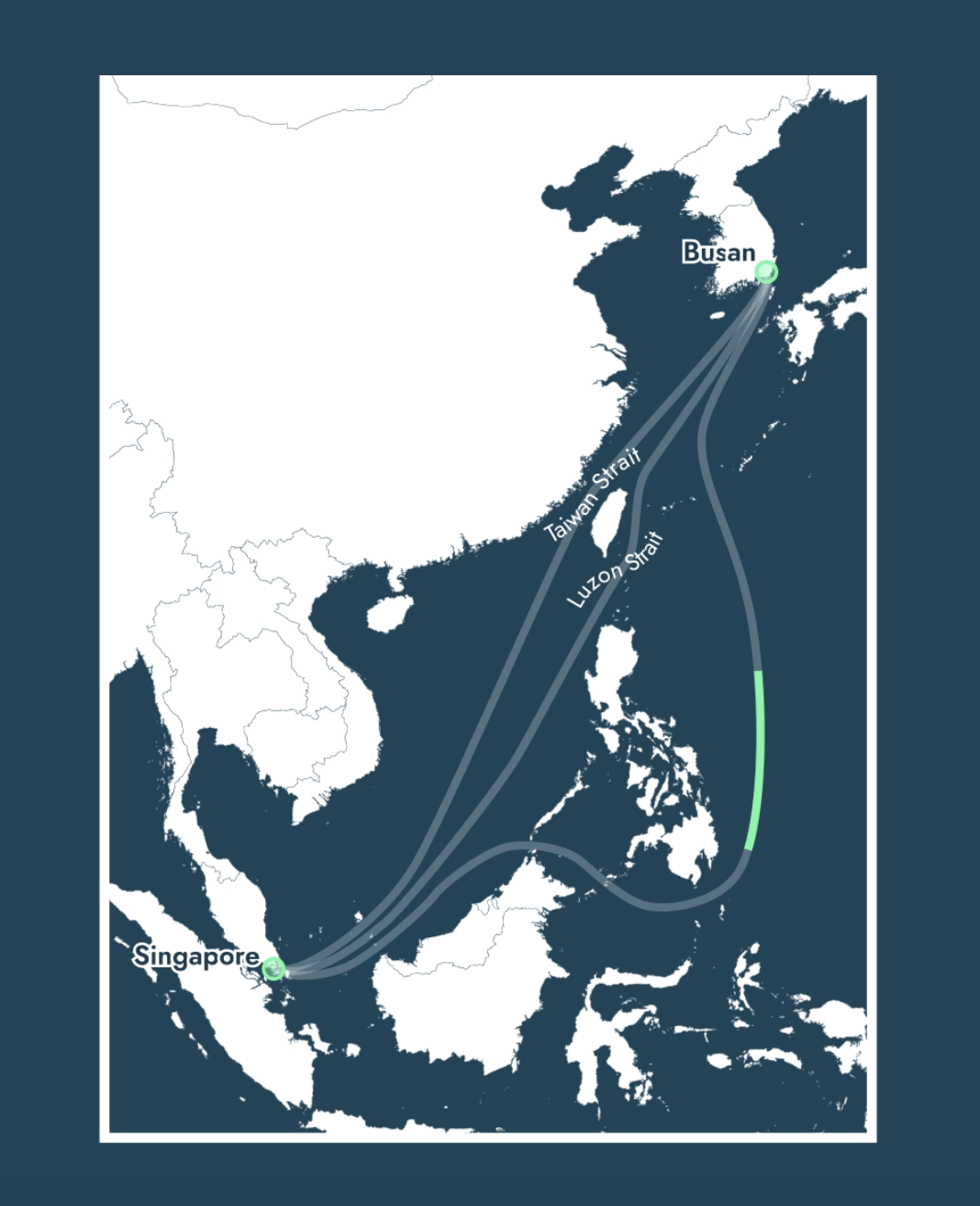
Closure of trade and shipping in the Taiwan Strait would not only affect Taiwan, South Korea and Japan, but also China: $1.3 trillion of Chinese imports and exports travel through the strait, more than any other country. In this sense, China is heavily reliant on the sea lane remaining open—at least to its own ships, which are about half of all the vessels transiting through. Beijing policymakers are sure to be aware of this, and it is a significant constraint to any military assault on Taiwan.
Another important concession must also be made here. Taiwanese chips, manufactured by TSMC, are largely shipped via air. So, if there are alternate routes, and China can’t fully close the main Taiwan Strait, what’s the issue?
Just like the current strait crisis, the primary threat to U.S. and Taiwanese economic security lies in the foundational materials that make the production of these chips possible. China doesn’t need to stop the high-value cargo to hurt the AI industry in America—it just needs to prevent the high-volume precursor cargo that keeps Taiwanese TSMC factories alive: the foundry equipment, the industrial chemicals, and the energy to keep it all going.
China has been preparing a maritime force for just this purpose: Beyond the ‘grey-hulled’ PLAN units, China has recently introduced new secondary and tertiary marine forces: the ‘white-hulled’ Chinese Coast Guard (CCG) and the ‘blue-hulled’ People’s Armed Forces Maritime Militia (PAFMM).[1] Increasingly, these paranaval forces operate on the front lines of Chinese maritime engagement between the ‘grey zone’ of war and peace.[2] Beijing uses these forces to further its unresolved claims within the first island chain, employing an approach that allows China to “win without fighting.” The conduct of these operations is more intensely assertive than ordinary interstate relations, but less extreme than armed conflict—the object is to use coercive, nonlethal means to advance its maritime strategy.[3] Indeed, the contentious nature of such activities is reflected in how Chinese forces describe the situation: “war without gun smoke.”[4]
For these ‘grey zone’ operations, the PAFMM is well equipped. Their ships resemble fishing trawlers, yet they are professionalised and militarised, outfitted with purpose-built water cannons and external rails perfect for spraying and ramming. Because these ships are so “cost-effective and versatile,” they are deployed in the South China Sea to monitor foreign activities in Chinese-claimed waters.[5] Although inferior to their sister PLAN and CCG in technological sophistication, their civilian guise allows them to be omnipresent, filling in the gaps in the operational picture of the disputed areas, and allowing them to perform missions that might be deemed too provocative if undertaken by naval services.
If China chose to blockade the Taiwan Strait, an option contemplated by Western analysts, it would likely create a chaotic kinetic situation, requiring naval and military action by opposing forces. Consequentially, all merchant vessels would not be able navigate the passage due to higher risk, akin to the Strait of Hormuz. However, if the PRC instead chose to close the Taiwan Strait to non-Chinese vessels, they could enforce this rather fragile ‘quarantine’ using the PAFMM—operating to intimidate Taiwanese and American allied cargo ships, even mandating inspections and confiscating ‘sanctioned’ elements required for chip manufacturing. If insurers can’t cover shipments of LNG, sulphuric acid, or other prerequisite components, the industry might stop just as surely as if the ships were sunk. China just needs to create enough of what Clausewitz termed ‘friction,’ or forces the make actions in war harder, to make a Taiwan Strait crisis just as hard to control as the current situation in the Middle East.
Conclusions
So far, the Trump doctrine has attempted to increase American control over the trade of goods by sea; to reopen sea lines of communication against an increasingly agitated China. Yet, China will be aware of the real risks of closing a maritime chokepoint. In the case of Taiwan, the primary chokepoint would significantly hurt their own economy, restricting, at least currently, their strategic options for influencing the American AI industry. But the ‘quarantine’ option like the one outlined above could still be on the table. Policymakers should be aware of these options, and the threats posed to an industry that is currently driving the American economy. During this Dire Strait situation—as the trade of the Sultans swing in the balance—China will be drawing up contingencies, which the West must anticipate.
Footnotes
[1] Erickson, Andrew S., and Ryan D. Martinson. China's Maritime Gray Zone Operations. Annapolis, MD: Naval Institute Press, 2019, 2.
[2] Ibid., 1.
[3] Ibid., 2.
[4] Ibid., 3.
[5] Ibid., 3.